For decades, getting a college degree was considered one of the safest investments a student could make. A traditional degree from a respected university could open doors to professional jobs, higher salaries, and long term career growth. But the job market is changing quickly, and artificial intelligence is changing what employers look for in candidates.
In 2026, students have more choices than ever. They can spend several years completing a traditional degree, develop specialized AI skills through shorter programs, or combine formal education with practical artificial intelligence experience.
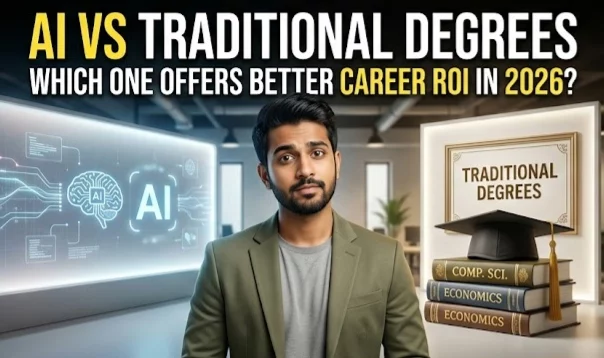
This raises an important question: AI skills vs traditional degrees, which one offers better career ROI in 2026?
The answer is not as simple as choosing one over the other. A degree still has significant value, but practical AI skills can provide a faster route to employability and higher earning potential in many technology focused careers.
What Does Career ROI Actually Mean?
Career ROI refers to the return you receive from the time, money, and effort invested in your education or professional training.
For example, if someone spends several years and a large amount of money earning a degree, their career ROI depends on factors such as starting salary, employment opportunities, career progression, education costs, and how quickly they recover their investment.
AI focused learning can have a different ROI model. Some learners can develop useful skills through online programs, professional certifications, bootcamps, university courses, and practical projects without spending several years completing another full degree.
This does not automatically make AI training better. The value depends heavily on the career someone wants to enter.
Why AI Skills Are Becoming More Valuable
Artificial intelligence is no longer limited to specialist research teams. Companies are using AI for software development, marketing, customer service, finance, healthcare, data analysis, cybersecurity, product development, and business operations.
The World Economic Forum has identified AI and big data among the fastest growing skills expected to increase in importance through 2030. AI and machine learning specialists are also among the technology roles expected to grow strongly.
More recent labor market research also shows that AI skills are gaining measurable value. A 2026 World Economic Forum analysis found that job candidates with AI related skills received a significant wage premium in the UK job market compared with otherwise similar candidates without those skills.
This is an important change because employers are increasingly interested in what candidates can actually do, not simply what qualification appears on their resume.
Where Traditional Degrees Still Have an Advantage
It would be a mistake to assume that traditional degrees are becoming useless.
A university degree remains extremely valuable in professions where formal education is a fundamental requirement. Medicine, law, architecture, engineering, accounting, scientific research, and several regulated professions often require recognized academic qualifications.
A degree can also provide something that short AI courses cannot easily replicate: structured education.
Students can spend several years developing mathematics, communication, research, analytical thinking, teamwork, and subject specific knowledge. University also provides access to professors, classmates, internships, laboratories, career services, and professional networks.
For someone who wants to become a machine learning researcher, for example, a strong academic background in computer science, mathematics, statistics, or a related field can be extremely valuable.
The important point is that a degree and AI skills do not necessarily compete with each other. In many cases, they work better together.
Where AI Skills Can Deliver Better ROI
AI focused skills can offer an attractive return for people who want to enter the technology industry quickly or upgrade their existing careers.
Learning tools such as Python, machine learning frameworks, generative AI systems, data analysis platforms, cloud services, automation tools, and AI application development can create practical career opportunities without requiring another four year degree.
This is particularly useful for professionals who already have a degree but want to move into technology. A marketing professional who learns AI automation can become more valuable within marketing. A software developer who learns generative AI can move toward AI application development. A data analyst who develops machine learning skills can pursue more advanced roles.
The goal is not simply to collect AI certificates. Employers want evidence that a candidate can use technology to solve real problems.
AI Skills vs Degree: Salary Potential
Salary depends on location, industry, experience, company size, specialization, and the level of responsibility involved. Therefore, there is no universal salary advantage for either path.
However, current evidence suggests that specialized AI capabilities can attract a meaningful premium. Research highlighted by the World Economic Forum found that AI skills were associated with higher advertised salaries than comparable candidates without those skills.
In India, recent employer research has also pointed toward increasing pay differentiation based on AI and data skills. Deloitte India reported that AI and data skills can attract a substantial compensation premium, while employers are placing greater emphasis on specialization and demonstrable skills.
This means that the highest ROI may come from combining education with specialized skills rather than relying entirely on a degree title.
The Problem With Choosing AI Skills Alone
There is another side to the discussion.
AI tools are becoming easier to use. Someone can learn prompting, automation, and basic AI applications relatively quickly. But that does not mean every short AI course will lead to a high paying job.
The market is becoming more competitive. Employers still need people who understand fundamentals, can communicate clearly, evaluate results, solve unfamiliar problems, and take responsibility for their work.
A person who knows how to use an AI tool but does not understand the underlying business or technical problem may struggle to compete with someone who combines AI knowledge with strong professional expertise.
That is why practical depth matters more than simply adding the words AI expert to a resume.
The Best Strategy in 2026: Combine Both
For many students and professionals, the strongest career strategy is not AI skills versus a traditional degree. It is a combination of education and AI capability.
A computer science graduate who learns machine learning and generative AI can be more competitive than someone with only a computer science degree.
A finance graduate who learns AI based financial analysis can differentiate themselves from candidates with similar finance qualifications.
A business graduate who understands AI automation, analytics, and digital products can become valuable in organizations undergoing AI transformation.
This combination creates a powerful career profile because the individual understands both the subject area and the technology being used to improve it.
What Employers Want in 2026
Employers are increasingly looking for a mixture of technical and human capabilities. The World Economic Forum expects AI and big data, cybersecurity, and technological literacy to remain among the fastest growing skill areas, while creative thinking, adaptability, curiosity, and lifelong learning are also becoming more important.
That means students should not focus exclusively on technical tools.
Communication, critical thinking, leadership, problem solving, creativity, and business understanding can make AI professionals significantly more effective.
Recent research in India also indicates that employers are increasingly evaluating candidates on learning agility, behavioral competencies, and practical readiness rather than relying exclusively on academic credentials.
Who Should Choose a Traditional Degree?
A traditional degree may be the better investment if you are starting your education and want access to professions that require formal qualifications.
It is also a strong choice if you want structured learning, university research opportunities, internships, academic networks, or careers where educational credentials carry substantial weight.
Students interested in computer science, engineering, medicine, finance, law, or scientific research can still benefit enormously from a strong university education.
Who Should Prioritize AI Skills?
AI focused learning can make more sense for professionals who already have an educational background and want to upgrade their career.
It can also be useful for freelancers, entrepreneurs, software developers, analysts, marketers, designers, business professionals, and students who want to develop practical technology capabilities alongside their formal education.
If your objective is to improve employability quickly, focused AI training combined with real projects can sometimes provide a faster return than starting another full degree.
Final Words
The debate between AI skills and traditional degrees is likely to become even more important over the next few years. But the idea that one will completely replace the other is too simplistic.
A degree provides foundations, credibility, structured learning, and access to careers where formal qualifications matter. AI skills provide practical capabilities that are becoming increasingly valuable across industries.
For most people, the strongest career strategy in 2026 is to combine the two. Build a solid educational foundation, then continuously add AI, data, automation, and digital skills that are relevant to your industry.
The real career advantage will not belong to people who simply have the most certificates or the longest academic resume. It will belong to people who can combine knowledge with technology and use both to solve meaningful problems.
Frequently Asked Questions
Are AI skills more valuable than a college degree in 2026?
Not in every career. AI skills can provide excellent ROI in technology and digital roles, while degrees remain essential or highly valuable in many professional fields. Combining a degree with relevant AI skills can provide the strongest career advantage.
Can I get an AI job without a degree?
Yes, some AI related roles can be entered without a traditional degree, especially when candidates have strong practical skills, projects, portfolios, certifications, and relevant experience. However, advanced research and certain specialized positions may still prefer or require formal academic qualifications.
Is learning AI better than getting another degree?
It depends on your current situation. If you already have a degree and want to transition into technology, targeted AI training may provide a faster return. If you are entering higher education for the first time, a relevant degree combined with AI skills may provide broader long term opportunities.
Which AI skills should I learn in 2026?
Useful areas include generative AI, machine learning, Python, data analysis, AI automation, cloud computing, model deployment, AI application development, and responsible AI. The best choice depends on the career you want to build.
Do employers still care about college degrees?
Yes. Degrees remain important for many employers and professions. However, hiring is increasingly becoming more skills focused, particularly in rapidly changing technology fields. Demonstrable skills and practical experience can make a significant difference.
What gives better career ROI, an AI certification or a degree?
A certification can provide a faster and less expensive way to develop a specific skill, while a degree provides broader education and can unlock careers where formal qualifications are important. The better investment depends on your existing education, career target, budget, and experience.
Will AI replace traditional degrees?
AI is unlikely to make traditional degrees completely irrelevant. Instead, the value of education is changing. Employers increasingly want people who combine formal knowledge with current technology skills, practical experience, and strong human abilities.